
By Leia Watfa
Hello Centinal readers,
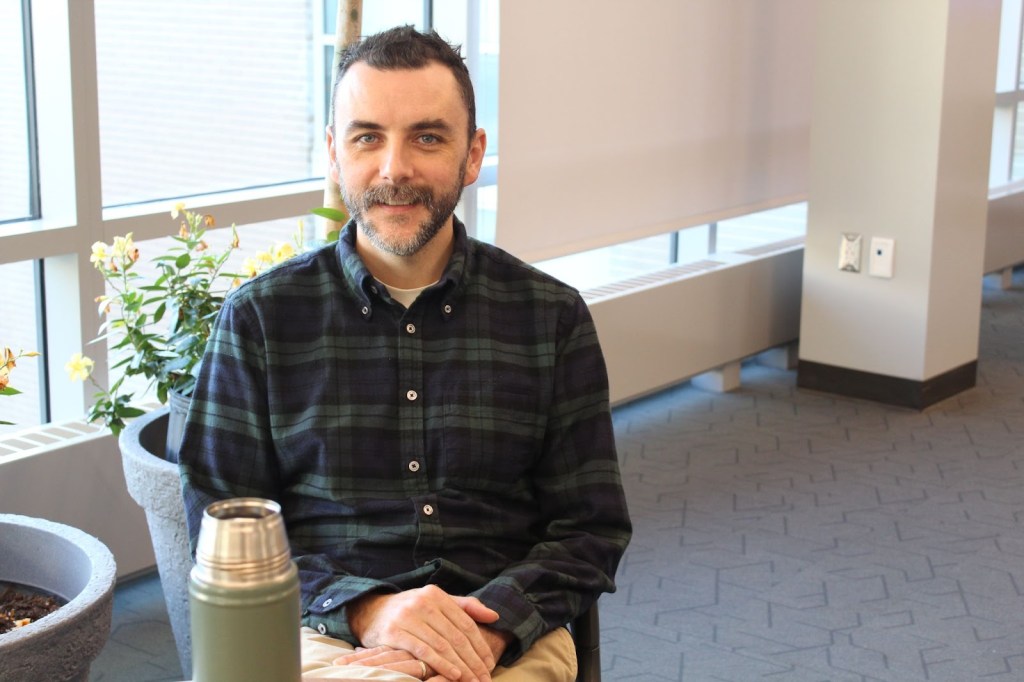
(On our one and only centinal.org website of course)! I’m here to interview Centennial’s (not really) one and only English teacher, Mr. Weinberg! He’s been teaching English for 20 years and currently teaches American Literature alongside AP Language and Composition. Mr. Weinberg is a man of many mysteries and allure, which I’m about to expose. Also not really. I chose to interview him because, through my experience in being his student, I’ve noticed Mr. Weinberg is a man with many, many thoughts, and a lot to say on the current state of basically everything. This interview aims to provide a look into the perspective of a teacher, and might possibly interest you to pursue the education path as well.
Let’s start off with the light ones: What is your teaching philosophy?
Weinberg: I haven’t really been asked to articulate a philosophy of education since I applied to the college of education during my sophomore year at University of Illinois, saying my philosophy of education, the purpose of education for me was to foster agency and choice in students. I think that’s probably the same still.
What’s your favorite thing to see in your students’ work?
Weinberg: Creativity and risks, you know? I think by and large, I have a lot of students that are so afraid of doing something wrong that they cling to scaffolds and models and examples, and that comes at the expense of personality and voice. So, I do like it when kids take chances in their writing, and insert themselves in it.
What’s your favorite thing to teach throughout the school year?
Weinberg: Well I currently teach two courses, I teach AP lang, which is nonfiction and argument based. I didn’t think I would like that at all going into it, since I rarely read nonfiction, but the class changed my opinion teaching it. I enjoy teaching a lot of the units in that class, I like the one that we’re currently on, exploring that question about whether or not our schools are providing true education for students. There’s a unit on money, the question we’re exploring is, “what is the role of money in our everyday life?”, that brings up a lot of important ethical questions about consumerism and consumption, so I like that too.
Has the school improved much during your time working here?
Weinberg: That’s a big question, I’ve seen progress in a lot of areas. When I started working here it was around 2004 or 2005, and things felt a little bit more stratified or factionalized within the student body, and it seems to be a little more unity, more integration, just in the informal social spaces where students arrange themselves. So, I would say we’ve made progress in that regard.
If you could change the school in any way, what would you do?
Weinberg: I think during the pandemic there was a version of our school day where it didn’t start until 9 and it ended relatively early too. During that time period the class periods were shorter, and there was more time built into the day for planning, prepping, and grading, my turnaround and feedback for students was so quick. And so I think one change I would do is more time built into the school day for teacher preparation. I think I could be a better teacher if I had more time to provide feedback on student writing.
What’s your biggest takeaway from teaching, or just something you didn’t expect from it that you’d wanna tell anyone interested in pursuing the education path?
Weinberg: I think what brought me to teaching was the subject matter, English, but the longer in that, I don’t wanna diminish my passion for English or anything, but that sort of peripheral “it’s the students not the subject matter” that keeps me excited to come back to school, year in year out. So, I didn’t expect that necessarily.
Okay so now that the boring questions are over, this is the only question with a correct answer: who’s your favorite student? Hint: starts with L and ends in eia
Weinberg: Well that’s a no brainer there. Don’t even need to say.
What do you think about during your long window gazing sessions?
Weinberg: Probably looking across the courtyard at my wife, Mrs. McMenamin.
Is the chalk story where you ate chalk and made a student cry real?
Weinberg: ..No comment
Lightning round: What’s your favorite book, color, movie, and subject besides english?
Weinberg: I have a short memory so my favorite book is usually the one I read most recently, which in this case I’m currently reading this dystopian novel called Prophet Song, by Paul Lynch, and I’m really into it. Takes place in Dublin, civil rights are stripped from citizens and they’re persecuted by the state, not a genre I normally read but I like it. Favorite color, black. Favorite movie, probably It’s a Wonderful Life, or Groundhog Day. In a lot of ways they have the same message, as an English teacher, my takeaway from those films is about editing and revising your life as a narrative, through the mistakes you make and working on that. Other favorite subject, meteorology, no brainer, I’m obsessed with the weather. If I weren’t a teacher I would like to study the weather.
Thoughts on the increasing amount of virtual schooling and virtual shopping and virtual everything?
Weinberg: Not a very online person, it’s not for me. I left social media a couple years ago because I thought those ads were too effective on me. I found myself wanting or buying things that I didn’t really need. So, I try to be less wasteful in my life and to consume less, so that means unplugging in a lot of ways.
What’s your deepest darkest secret?
Weinberg: OH. Can’t say anything.
To make this relevant to the interview, if you got to pick now, what would your last words be?
Weinberg: I dunno, “thanks a lot”? Depends how I die. “Ouch”.
Ending the interview with an absolute gem of a quote, what a way to go! When asked if he had any closing statements for the readers, Mr. Weinberg denied and said to get rid of all the “um’s” (there was a lot) and duds. To be fair, I’m surprised with his on the fly answers that were so in-depth. Definitely a special thanks to him for agreeing to this interview (and for following my request of including as many complicated words as possible to force readers to google them). Before the main point mentioned previously, my original idea for writing this article came from wanting to show the humanity of teachers. I feel like when we’re younger, we see teachers as these authoritative figures that are just there to tell us what to do, but as we grow older they become more known to us and we see all their human flaws and traits, which in of itself is pretty cool to grow and see more of. Writing this and interviewing Mr. Weinberg definitely helped me see through the lens of a teacher, and really come to understand them as a whole, so I hope this did the same for you too.
 The Centinal - Centennial High School's Online Publication